 Add to Chrome
 Add to Firefox
 Add to Edge
Co-GLANCE: Uncertainty-Aware Active Perception for Heterogeneous Robot Teaming
Jun 07, 2026
Perceptual uncertainty is a central challenge for heterogeneous robot teams operating in unstructured outdoor environments, where no single viewpoint affords reliable scene understanding. Perceptual uncertainty, arising from sources such as occlusions, manifests differently across robot viewpoints depending on scene structure. Detecting and resolving sources of perceptual uncertainty requires both scene-based contextual reasoning and capability-aware robot allocation. While vision-language models provide strong semantic priors for both, they are computationally prohibitive for onboard inference and lack calibrated uncertainty quantification. We introduce Co-GLANCE, a real-time onboard perception and decision-making system for uncertainty resolution in heterogeneous robot teams. Co-GLANCE distills the semantic reasoning capabilities of a vision-language model into an end-to-end model for occlusion segmentation and robot allocation, eliminating the need for cloud-based inference. To quantify perceptual uncertainty, Co-GLANCE combines conformal prediction with selective abstention to provide statistically valid coverage guarantees for segmentation, robot allocation, and detection outputs. These calibrated uncertainty estimates directly trigger active perception, dispatching the most appropriate robot to acquire informative viewpoints and resolve uncertainty. Across real-world scenarios, Co-GLANCE outperforms cloud-based vision-language model baselines in occlusion segmentation and robot allocation accuracy by 25% and 36%, respectively, while reducing per-frame inference latency 350x. We also release an air-ground dataset for future research. Code, videos, and dataset available at https://co-glance.github.io/ .

What Objects Enable, Not What They Are: Functional Latent Spaces for Affordance Reasoning
Jun 04, 2026Existing robot planning systems rely on appearance-based reasoning, where visual observations are encoded into latent spaces organized around object appearances (e.g., recognizing a "cart" based on how it looks). However, planning requires reasoning about task-relevant functionalities of objects (e.g., whether an object is "movable"), which appearance-based latent spaces do not capture. As a result, existing approaches struggle to generalize to novel robot-object interactions. We address this limited generalizability through affordance reasoning, enabling planning based on task-relevant object functionalities instead of appearance alone. We introduce A4D, which maps visual observations into a shared latent space structured around affordances (e.g., "movable"). By projecting visual observations into this functional latent space and measuring their proximity to affordances, A4D infers functionalities relevant to the observed object. Furthermore, we introduce an affordance discovery mechanism that expands the latent space to handle unseen scenarios where existing affordances are insufficient. A4D uses proximity in the functional latent space to quantify uncertainty in affordance inference and selectively triggers affordance discovery. We evaluate A4D across several planning tasks involving diverse and unseen affordances. A4D achieves 94% inference accuracy on existing affordances outperforming state-of-the-art approaches by over 15% points, improves new-affordance inference accuracy from 70% to over 90% with fewer than 10% of the original training data, and enables 100x faster inference. Code, videos, and data available at: https://A4Dance-reasoning.github.io.
Efficiently Solving Mixed-Hierarchy Games with Quasi-Policy Approximations
Feb 02, 2026Multi-robot coordination often exhibits hierarchical structure, with some robots' decisions depending on the planned behaviors of others. While game theory provides a principled framework for such interactions, existing solvers struggle to handle mixed information structures that combine simultaneous (Nash) and hierarchical (Stackelberg) decision-making. We study N-robot forest-structured mixed-hierarchy games, in which each robot acts as a Stackelberg leader over its subtree while robots in different branches interact via Nash equilibria. We derive the Karush-Kuhn-Tucker (KKT) first-order optimality conditions for this class of games and show that they involve increasingly high-order derivatives of robots' best-response policies as the hierarchy depth grows, rendering a direct solution intractable. To overcome this challenge, we introduce a quasi-policy approximation that removes higher-order policy derivatives and develop an inexact Newton method for efficiently solving the resulting approximated KKT systems. We prove local exponential convergence of the proposed algorithm for games with non-quadratic objectives and nonlinear constraints. The approach is implemented in a highly optimized Julia library (MixedHierarchyGames.jl) and evaluated in simulated experiments, demonstrating real-time convergence for complex mixed-hierarchy information structures.
BEV-Patch-PF: Particle Filtering with BEV-Aerial Feature Matching for Off-Road Geo-Localization
Dec 17, 2025We propose BEV-Patch-PF, a GPS-free sequential geo-localization system that integrates a particle filter with learned bird's-eye-view (BEV) and aerial feature maps. From onboard RGB and depth images, we construct a BEV feature map. For each 3-DoF particle pose hypothesis, we crop the corresponding patch from an aerial feature map computed from a local aerial image queried around the approximate location. BEV-Patch-PF computes a per-particle log-likelihood by matching the BEV feature to the aerial patch feature. On two real-world off-road datasets, our method achieves 7.5x lower absolute trajectory error (ATE) on seen routes and 7.0x lower ATE on unseen routes than a retrieval-based baseline, while maintaining accuracy under dense canopy and shadow. The system runs in real time at 10 Hz on an NVIDIA Tesla T4, enabling practical robot deployment.
Zero to Autonomy in Real-Time: Online Adaptation of Dynamics in Unstructured Environments
Sep 15, 2025Autonomous robots must go from zero prior knowledge to safe control within seconds to operate in unstructured environments. Abrupt terrain changes, such as a sudden transition to ice, create dynamics shifts that can destabilize planners unless the model adapts in real-time. We present a method for online adaptation that combines function encoders with recursive least squares, treating the function encoder coefficients as latent states updated from streaming odometry. This yields constant-time coefficient estimation without gradient-based inner-loop updates, enabling adaptation from only a few seconds of data. We evaluate our approach on a Van der Pol system to highlight algorithmic behavior, in a Unity simulator for high-fidelity off-road navigation, and on a Clearpath Jackal robot, including on a challenging terrain at a local ice rink. Across these settings, our method improves model accuracy and downstream planning, reducing collisions compared to static and meta-learning baselines.
Temporally Consistent Unsupervised Segmentation for Mobile Robot Perception
Jul 29, 2025Rapid progress in terrain-aware autonomous ground navigation has been driven by advances in supervised semantic segmentation. However, these methods rely on costly data collection and labor-intensive ground truth labeling to train deep models. Furthermore, autonomous systems are increasingly deployed in unrehearsed, unstructured environments where no labeled data exists and semantic categories may be ambiguous or domain-specific. Recent zero-shot approaches to unsupervised segmentation have shown promise in such settings but typically operate on individual frames, lacking temporal consistency-a critical property for robust perception in unstructured environments. To address this gap we introduce Frontier-Seg, a method for temporally consistent unsupervised segmentation of terrain from mobile robot video streams. Frontier-Seg clusters superpixel-level features extracted from foundation model backbones-specifically DINOv2-and enforces temporal consistency across frames to identify persistent terrain boundaries or frontiers without human supervision. We evaluate Frontier-Seg on a diverse set of benchmark datasets-including RUGD and RELLIS-3D-demonstrating its ability to perform unsupervised segmentation across unstructured off-road environments.
Foundation Models for Logistics: Toward Certifiable, Conversational Planning Interfaces
Jul 15, 2025Logistics operators, from battlefield coordinators rerouting airlifts ahead of a storm to warehouse managers juggling late trucks, often face life-critical decisions that demand both domain expertise and rapid and continuous replanning. While popular methods like integer programming yield logistics plans that satisfy user-defined logical constraints, they are slow and assume an idealized mathematical model of the environment that does not account for uncertainty. On the other hand, large language models (LLMs) can handle uncertainty and promise to accelerate replanning while lowering the barrier to entry by translating free-form utterances into executable plans, yet they remain prone to misinterpretations and hallucinations that jeopardize safety and cost. We introduce a neurosymbolic framework that pairs the accessibility of natural-language dialogue with verifiable guarantees on goal interpretation. It converts user requests into structured planning specifications, quantifies its own uncertainty at the field and token level, and invokes an interactive clarification loop whenever confidence falls below an adaptive threshold. A lightweight model, fine-tuned on just 100 uncertainty-filtered examples, surpasses the zero-shot performance of GPT-4.1 while cutting inference latency by nearly 50%. These preliminary results highlight a practical path toward certifiable, real-time, and user-aligned decision-making for complex logistics.
Spatiotemporal Contrastive Learning for Cross-View Video Localization in Unstructured Off-road Terrains
Jun 05, 2025Robust cross-view 3-DoF localization in GPS-denied, off-road environments remains challenging due to (1) perceptual ambiguities from repetitive vegetation and unstructured terrain, and (2) seasonal shifts that significantly alter scene appearance, hindering alignment with outdated satellite imagery. To address this, we introduce MoViX, a self-supervised cross-view video localization framework that learns viewpoint- and season-invariant representations while preserving directional awareness essential for accurate localization. MoViX employs a pose-dependent positive sampling strategy to enhance directional discrimination and temporally aligned hard negative mining to discourage shortcut learning from seasonal cues. A motion-informed frame sampler selects spatially diverse frames, and a lightweight temporal aggregator emphasizes geometrically aligned observations while downweighting ambiguous ones. At inference, MoViX runs within a Monte Carlo Localization framework, using a learned cross-view matching module in place of handcrafted models. Entropy-guided temperature scaling enables robust multi-hypothesis tracking and confident convergence under visual ambiguity. We evaluate MoViX on the TartanDrive 2.0 dataset, training on under 30 minutes of data and testing over 12.29 km. Despite outdated satellite imagery, MoViX localizes within 25 meters of ground truth 93% of the time, and within 50 meters 100% of the time in unseen regions, outperforming state-of-the-art baselines without environment-specific tuning. We further demonstrate generalization on a real-world off-road dataset from a geographically distinct site with a different robot platform.
Online Adaptation of Terrain-Aware Dynamics for Planning in Unstructured Environments
Jun 04, 2025Autonomous mobile robots operating in remote, unstructured environments must adapt to new, unpredictable terrains that can change rapidly during operation. In such scenarios, a critical challenge becomes estimating the robot's dynamics on changing terrain in order to enable reliable, accurate navigation and planning. We present a novel online adaptation approach for terrain-aware dynamics modeling and planning using function encoders. Our approach efficiently adapts to new terrains at runtime using limited online data without retraining or fine-tuning. By learning a set of neural network basis functions that span the robot dynamics on diverse terrains, we enable rapid online adaptation to new, unseen terrains and environments as a simple least-squares calculation. We demonstrate our approach for terrain adaptation in a Unity-based robotics simulator and show that the downstream controller has better empirical performance due to higher accuracy of the learned model. This leads to fewer collisions with obstacles while navigating in cluttered environments as compared to a neural ODE baseline.
PSN Game: Game-theoretic Planning via a Player Selection Network
Apr 30, 2025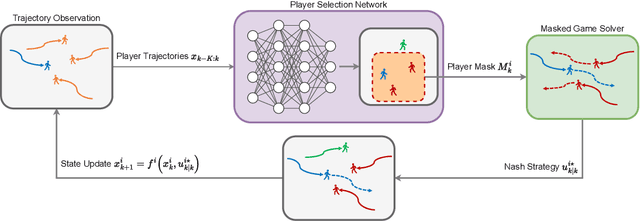
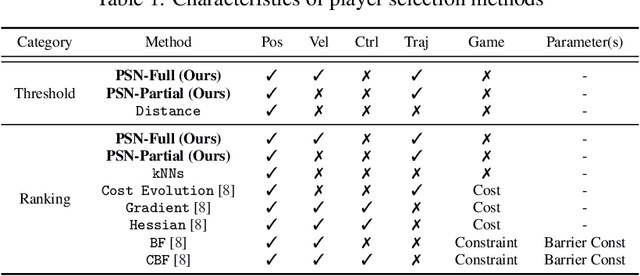
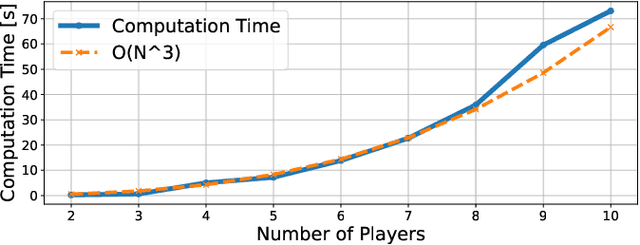
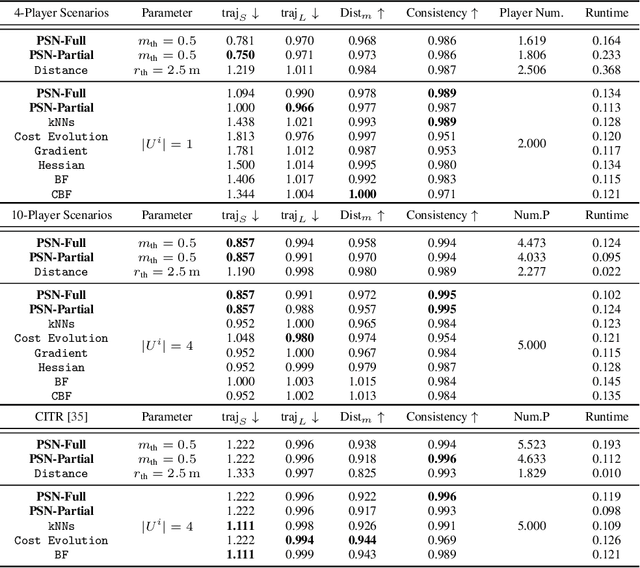
While game-theoretic planning frameworks are effective at modeling multi-agent interactions, they require solving optimization problems with hundreds or thousands of variables, resulting in long computation times that limit their use in large-scale, real-time systems. To address this issue, we propose PSN Game: a novel game-theoretic planning framework that reduces runtime by learning a Player Selection Network (PSN). A PSN outputs a player selection mask that distinguishes influential players from less relevant ones, enabling the ego player to solve a smaller, masked game involving only selected players. By reducing the number of variables in the optimization problem, PSN directly lowers computation time. The PSN Game framework is more flexible than existing player selection methods as it i) relies solely on observations of players' past trajectories, without requiring full state, control, or other game-specific information; and ii) requires no online parameter tuning. We train PSNs in an unsupervised manner using a differentiable dynamic game solver, with reference trajectories from full-player games guiding the learning. Experiments in both simulated scenarios and human trajectory datasets demonstrate that i) PSNs outperform baseline selection methods in trajectory smoothness and length, while maintaining comparable safety and achieving a 10x speedup in runtime; and ii) PSNs generalize effectively to real-world scenarios without fine-tuning. By selecting only the most relevant players for decision-making, PSNs offer a general mechanism for reducing planning complexity that can be seamlessly integrated into existing multi-agent planning frameworks.